



STOMACH CANCER – SYMPTOMS, CAUSES, TREATMENT
-
Author: BỆNH VIỆN ĐA KHOA QUỐC TẾ NAM SÀI GÒN
-
 18/05/2022
-
 6,880
6,880

Stomach cancer, which is also called gastric cancer, is cancer that begins in the stomach. Learn about symptoms, causes, detection and treatments.

Gastric cancer is a serious disease with a high mortality rate and is becoming increasingly common. According to GLOBOCAN 2022 statistics, Vietnam records 16,277 new cases and 13,264 deaths from gastric cancer each year. It is among the five most common cancers and ranks as one of the three leading causes of cancer-related deaths in the country.
In this article, Dr. NGUYEN VU QUANG, MMed, Specialist Level I, from the Department of General Surgery at Nam Sai Gon International General Hospital, will help you understand the causes, symptoms, diagnostic methods, and treatment options for gastric cancer, as well as effective measures for disease prevention.

What is stomach cancer?
Gastric cancer occurs when cells in the stomach grow abnormally and uncontrollably, forming a tumor. It typically begins in the gastric mucosa and gradually spreads, metastasizing to other parts of the body such as the liver, lungs, and bones through the bloodstream, lymphatic system, or direct spread within the abdominal cavity.

Gastric cancer often develops silently, with vague or no symptoms in the early stages. As a result, many cases are diagnosed at an advanced stage, increasing the risk of mortality.
Gastric cancer is classified into stages from 0 to IV, as follows:
Stage 0
The cancer is confined to the mucosal layer (carcinoma in situ), with no invasion or metastasis.
Stage I
-
Stage IA: The tumor invades the submucosa, with no lymph node or distant metastasis.
-
Stage IB: The tumor invades the muscular layer or submucosa and spreads to 1–2 lymph nodes.
Stage II
-
Stage IIA: The tumor invades the subserosa or spreads to 3–6 lymph nodes.
-
Stage IIB: The tumor invades through the serosal layer or involves a greater number of lymph nodes.
Stage III
-
Stage IIIA: The tumor invades multiple layers of the stomach wall and nearby lymph nodes.
-
Stage IIIB: The tumor has invaded adjacent organs or shows extensive lymph node metastasis.
-
Stage IIIC: The tumor has invaded adjacent organs and has widespread lymph node metastasis.
Stage IV
Distant metastases to organs outside the stomach are present, marking the most advanced stage of gastric cancer.
Determining the stage of gastric cancer helps physicians select the most appropriate treatment options, such as surgery, chemotherapy, radiotherapy, or other therapeutic approaches.
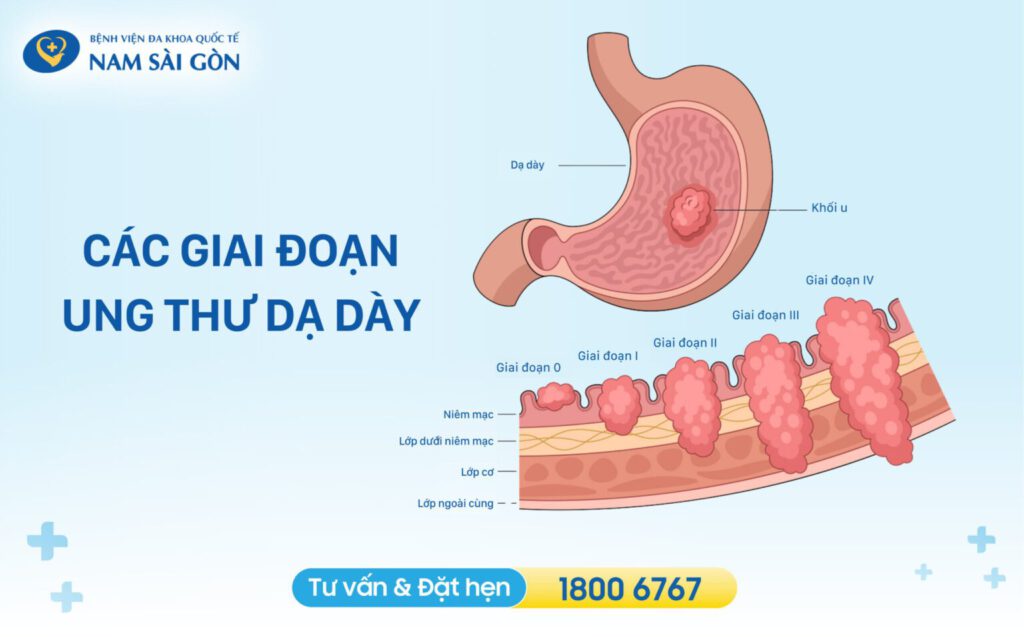
Stages of Gastric Cancer
Causes of Gastric Cancer
The exact cause of gastric cancer has not yet been clearly identified. However, many factors—both genetic and lifestyle-related—are known to increase the risk of developing the disease.
Below are some of the main risk factors for gastric cancer:
-
Helicobacter pylori (H. pylori) infection:
H. pylori is a bacterium that infects the stomach and can cause gastritis and peptic ulcers, leading to damage of the gastric mucosa. Long-term H. pylori infection may result in precancerous changes in the stomach lining and eventually progress to gastric cancer. -
Dietary factors:
A diet high in salt, processed foods, grilled or smoked foods containing nitrites and nitrates can lead to the formation of carcinogenic compounds in the stomach. -
Obesity:
Obesity is considered a risk factor, particularly for cancers occurring in the upper part of the stomach near the esophagus. -
Underlying medical conditions:
Individuals with chronic gastritis or pernicious anemia have a higher risk of developing gastric cancer. -
Gastric polyps:
These are abnormal cell growths that form on the inner lining of the stomach. Most gastric polyps are benign; however, in some cases—especially when polyps are larger than 1 cm, depending on the type—they may become malignant and lead to gastric cancer. -
Family history:
People with a family history of gastric cancer are at increased risk. Certain hereditary syndromes, such as Lynch syndrome and familial adenomatous polyposis (FAP), also raise the likelihood of developing the disease. -
Smoking and alcohol consumption:
Smoking increases the risk of gastric cancer, especially in the upper stomach near the esophagus. Excessive alcohol consumption also contributes to the development of gastric cancer. -
Age and gender:
Gastric cancer is more common in individuals over the age of 50 and occurs more frequently in men than in women.
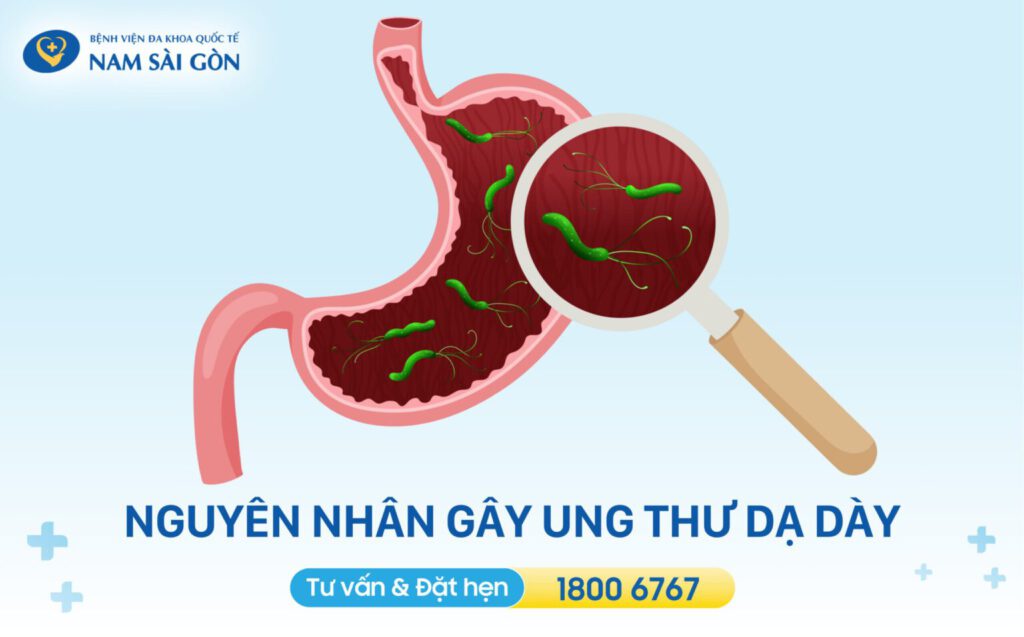
Helicobacter pylori (H. pylori) infection is one of the causes of gastric cancer.
Symptoms of Gastric Cancer
In the early stages, gastric cancer often has no symptoms or presents with vague symptoms that are easily mistaken for other gastric conditions. Patients should pay attention to the following signs to seek timely medical evaluation:
Early stage
-
Acid reflux, heartburn, or belching
-
Bloating, indigestion, abdominal pain
-
Poor appetite or loss of appetite
-
Unintentional weight loss, fatigue
-
Nausea or vomiting (may include vomiting blood)
-
Black stools mixed with blood
Advanced stage
-
A palpable mass felt in the abdomen
-
Declining health and general weakness (shortness of breath, difficulty breathing, rapid breathing, etc.)
-
Persistent abdominal pain and abdominal distension
-
Frequent vomiting
-
Black stools
-
Loss of appetite, early satiety, persistent fatigue
Diagnostic Methods for Gastric Cancer
To diagnose and determine the stage of gastric cancer, patients should visit a hospital for clinical evaluation and undergo several diagnostic tests as recommended by the physician, including:
Upper Gastrointestinal Endoscopy
This procedure allows direct examination of the esophagus, stomach, and duodenum using a flexible endoscope with a diameter of approximately 1 cm, which is inserted through the mouth. Images displayed on the endoscopy monitor enable physicians to identify abnormalities within the digestive tract and make an accurate diagnosis, as well as recommend appropriate treatment. If suspicious lesions and/or tumors are detected, a biopsy will be performed.
Gastric Biopsy
This involves obtaining a small tissue sample from the gastric mucosa, which is then examined under a microscope to detect the presence of cancer cells.
Diagnostic Imaging
CT scans, X-rays, PET scans, and MRI are used to determine the size of the tumor, the extent of invasion, and whether the cancer has metastasized.
Endoscopic Ultrasound (EUS)
This technique combines endoscopy and ultrasound to assess the depth of tumor invasion and detect metastasis to lymph nodes near the stomach.
Blood Tests
Blood tests are performed to evaluate tumor markers such as CA 72-4, CEA, CA 12-5, and CA 19-9, which are useful in monitoring treatment response.

Gastrointestinal endoscopy is one of the most effective methods for diagnosing gastric cancer.
Regular health screening plays a crucial role in the early detection of diseases, including gastric cancer, thereby improving treatment outcomes. Therefore, if you experience symptoms suggestive of gastric cancer or belong to a high-risk group, you should visit hospitals or medical facilities with specialized departments in Gastroenterology or Oncology for timely examination, screening, and treatment.
Treatment Options for Gastric Cancer
Treatment for gastric cancer depends on the stage of the disease. For very early-stage, localized gastric cancer, tumors may be removed endoscopically using techniques such as endoscopic mucosal resection (EMR) or endoscopic submucosal dissection (ESD). In subsequent stages, gastric cancer may be completely cured through surgical removal of part or all of the stomach along with nearby lymph nodes.
In contrast, at advanced stages when cancer cells have metastasized to other organs, treatment options are limited to chemotherapy, radiotherapy, targeted therapy, or palliative surgery aimed at managing tumor-related complications such as bleeding or gastric outlet obstruction.
The treatment methods applied for gastric cancer at each stage of disease progression are as follows:
-
Stage 0:
Surgical removal of part or all of the stomach along with nearby lymph nodes is performed and can often result in a complete cure. -
Stage I:
Similar to stage 0, treatment involves surgical resection of part or all of the stomach and adjacent lymph nodes. In addition, chemotherapy or radiotherapy may be used before and after surgery to shrink the tumor and eliminate any remaining cancer cells. -
Stage II:
Partial or total gastrectomy with removal of nearby lymph nodes remains the primary treatment. Chemotherapy or radiotherapy is also commonly used in combination before and after surgery. -
Stage III:
Total gastrectomy combined with chemotherapy and/or radiotherapy is typically applied at this stage. Gastric cancer at this stage still has a potential cure rate. If cure is not possible, physicians will select appropriate treatment options (such as radiotherapy, chemotherapy, medications, or laser therapy) based on the patient’s response to help relieve symptoms. -
Stage IV:
Treatment at this stage is very challenging. However, with strict adherence to the specialist’s treatment plan, the disease may be controlled and symptoms can be alleviated.

Although not all cases of gastric cancer can be prevented, you can take the following measures to reduce your risk of developing the disease:
-
Maintain a healthy diet:
Consume a balanced diet rich in vegetables, fruits, and fiber, while limiting processed foods, grilled foods, and fast food. -
Adopt a healthy lifestyle:
Engage in regular physical activity, ensure adequate rest, and limit alcohol consumption and tobacco use. -
Seek timely treatment for gastric conditions:
Promptly treat stomach-related diseases such as gastritis, peptic ulcers, Barrett’s esophagus, and Helicobacter pylori infection. -
Undergo regular health check-ups and early gastric cancer screening:
This is especially important for individuals at high risk.
Gastric Cancer Screening and Treatment at Nam Sai Gon International General Hospital
Gastric cancer is a highly aggressive and dangerous disease that requires early detection and timely treatment. Therefore, cancer screening plays a vital role in protecting the health of individuals and their families.
With a team of highly qualified and experienced physicians, combined with a modern medical equipment system, Nam Sai Gon International General Hospital provides comprehensive gastric cancer screening, treatment, and overall healthcare services to ensure the best possible outcomes for patients.
Nam Sai Gon International General Hospital
No. 88, Street No. 8, Trung Son Residential Area, Binh Hung Commune, Ho Chi Minh City.
Hotline: 18006767
info@nih.com.vn
Last updated: 15:52 15/01/2026


References

1. Abengozar, R., Sharma, A., & Sharma, R. (2021). Gastric cancer: lessons learned from high-incidence geographic regions. Journal of gastrointestinal oncology, 12(Suppl 2), S350. https://jgo.amegroups.org/article/view/41962/html
2. Conti, C. B., Agnesi, S., Scaravaglio, M., Masseria, P., Dinelli, M. E., Oldani, M., & Uggeri, F. (2023). Early gastric cancer: update on prevention, diagnosis and treatment. International journal of environmental research and public health, 20(3), 2149. https://www.mdpi.com/1660-4601/20/3/2149
3. Decourtye-Espiard, L., & Guilford, P. (2023). Hereditary diffuse gastric cancer. Gastroenterology, 164(5), 719-735. https://www.gastrojournal.org/article/S0016-5085(23)00110-5/fulltext
4. Dong, L., & Liu, D. (2021). Comparative Study of Serum Tumor Markers in the Diagnosis of Gastric Cancer and Colon Cancer. World Scientific Research Journal, 7(7), 36-43.
5. López, M. J., Carbajal, J., Alfaro, A. L., Saravia, L. G., Zanabria, D., Araujo, J. M., … & Fajardo, W. (2023). Characteristics of gastric cancer around the world. Critical Reviews in Oncology/Hematology, 181, 103841. https://www.sciencedirect.com/science/article/abs/pii/S1040842822002657?via%3Dihub
6. Ren, F., Shi, Z., Shen, X., Xiao, G., Zhang, C., & Cheng, Y. (2024). The global, regional, and national burden of stomach cancer attributed to smoking in 204 countries, 1990–2019: A systematic analysis for the Global Burden of Disease Study 2019. Tobacco Induced Diseases, 22. https://www.tobaccoinduceddiseases.org/The-global-regional-and-national-burden-of-stomach-cancer-nattributed-to-smoking,183803,0,2.html
7. Viện Ung Thư Quốc Gia, Tình hình bệnh ung thư tại Việt Nam theo GLOBOCAN 2022, nci.vn, https://nci.vn/tin-tuc/tinh-hinh-benh-ung-thu-tai-viet-nam-theo-globocan-2022-58
8. Bách, T. C., Lưu, N. K., & Đàn, N. V. (2022). NGHIÊN CỨU VAI TRÒ CỦA 18FDG-PET/CT TRONG CHẨN ĐOÁN GIAI ĐOẠN UNG THƯ DẠ DÀY. Tạp chí Y Dược học Quân sự, 47(8), 14-23. https://jmpm.vn/index.php/jmpm/article/view/154